Showing posts with label wood canvas canoe. Show all posts

Saturday, 31 January 2015

The Peterborough Canoe Co models: the High-end and Low-end Champlain


From left 1940's High End Champlain,  Early 1920's 604. Late 1920's 16 S. all of them built on the same form.

During winter, work slows down a bit and so do visits to the store and shop. However,  
most  Saturday mornings see customers and visitors drop in. Some stay around for a cup 
of coffee and canoe stories around the warm wood stove. Recently, one of my visitors wanted to know, how many different brands of canoes I had worked on, which were they and which model of them was the most common.

So I checked through my old files and notes; it all added up to a list of forty one names of old  famous canoe makers and some lesser known ones which had passed through my shop.

The most common ones are;
  1. Chestnut Canoe Co
  2. Peterborough Canoe Co
  3. Lakefield Canoe Co
 I     I was not surprised that the Chestnut Canoe Co and Peterborough Canoe Co took the 
 lead with Lakefield Canoe Co as a distant third. Those three companies, together, 
 produced an incredible amount of canoes over their life span and my shop is located right 
 in cottage country just north of Peterborough and Lakefield. As to the most common 
 models I have worked on, here is the group that was way ahead over the rest.
  1.      The 16’ Low End Champlain #1492 from Peterborough Canoe Co 
  2.        The 16’ Pal from Chestnut Canoe Co. 
  3.        The 16’ High End Champlain #1434 from Peterborough Canoe Co.
The visitor who asked the questions got very excited when finding out that the 
Peterborough model, the high end Champlain, had made the list, as it is the canoe he paddles. He now inquired, did I know how long time this model was in production and 
did I know anything about its background? 


Here is a little bit of background on the Champlain models.


Peterborough High-end Champlain and Peterborough Low-end Champlain


The Peterborough Canoe Co. model the "Champlain" showed up for the first time in 1936  in two versions, the “High-end” version with the model number 26P and the “Low-end”  version with the model number 26C. They were, however, just new names on models that  had been built for quite some time.The P stands for the Pleasure model and the C stands  for the Cruiser model. The monikers  High-end and Low-end has nothing to do with the  quality of the canoes, it actually describes  the height of the stern and bow. 

The Champlain models became the company's most popular canvas covered models.


The  Champlain High-End

The "High-End" Champlain model was produced between 1936 and 1955. In 1939 its model number was changed from 26P to #1434. However, before 1936, this model was actually called 16S or the Special and had been introduced for the 1923 model year as a less expensive model to their top of the line 604 model. (The 604 model changed name to the Otonabee in 1924).

16 S model, Peterborough Canoe Co.


The  Champlain Low-End

The Low-end Champlain was recommended for use in camps, tourist resorts and boat liveries where a light, stable and easy-to-portage canoe was desired. It was introduced in 1936 with the model # 26C. So was this really a new model? No it was not! 


It was introduced for the 1924 model year as the Algonquin (first grade) and the Huron (second grade). In 1936 it became the Champlain 26C and in 1939 the model number was changed to #1435. In 1942 the model number changed again, this time to #1492. 

The model Low-end Champlain was available until the end of 1962, when the Peterborough Canoe Co. went out of business. It is worth noting that the Peterborough Canoe Co never built the Low-end Champlain model. It was built for them by their sister companies Chestnut Canoe Co and occasionally by the  Canadian Canoe Co. This Peterborough model is actually the same canoe the Chestnut  Canoe Co built and sold under the names Ajax, Moonlight and after 1954 with the name  Pal.


Tuesday, 21 January 2014

Chestnut Indian Maiden canoe

Recently a lady called me asking if I had or knew of a Chestnut Indian/Maiden canoe for sale. She had seen the photos I had posted on Facebook of the latest Indian/Maiden I had restored for a customer  just last summer and wanted one. She had received one in birthday present in 1961. Unfortunately, that canoe had been destroyed in a storm some years later.

Chestnut Maiden restored summer 2013

Chestnut Maiden - new clothes 

I have restored several of this model, but no, I didn't have one for sale. So this blog posting is a short write-up about that canoe model and if you know of one give me a call, I know of a motivated buyer.

From its humble beginnings in the early 1900’s and an offering of only three models, the Chestnut Canoe Co had grown quickly. With the end of WWI and a renewed strong demand for their canoes the company added many more versions to their line-up of canoe models.

1934 catalogue page

The Chestnut Indian Maiden was one of those; it was introduced in 1922 in two versions, the Indian and the Maiden both 16 ft. in length. The difference was the finishes; the Indian with gunwales, thwarts, seats and decks trimmed in mahogany and the Maiden with spruce and ash gunwales, cedar decks and seats and thwarts in maple or ash.

The model was advertised as the craft for use at summer camps, resorts etc. and designed specifically for those wishing a jaunty looking distinctive model. It sure is distinctive, with its high and strongly curved ends. The hull-shape is very similar to the company's cruiser model with a narrow beam, an arched bottom and a very fine entry. In my mind, more a canoe for experienced paddlers not resort and camp paddlers. 

The Indian/Maiden model was offered for sale until the mid-1950’s. In 1960 and 1961 it showed up again in the company’s catalog. The model was also sold by the sister company Peterborough Canoe Co under the name “Iroquois”in 1960 and 1961.

Chestnut catalogue1961

In 1978 the Chestnut Canoe Co "dusted off" the old form with the intention to produce a Special Edition of three hundred canoes of the Indian Maiden model. The model was proudly displayed at the“show circuit” of 1978. 

Show circuit 1978

However, the Special Edition Indian Maiden was meet by very little interest – and apparently only three were built. Later the same year the company closed its doors for good. The Special Edition Indian Maiden has the distinction of being the last model built by the company.


Thursday, 26 December 2013

Chestnut Cruiser


A while back, I wrote briefly about a 16' Chestnut Cruiser slated for restoration. This model of paddling canoe is one of my favorites. I finished the restoration of this cruiser in the early summer of 2013 and had a chance to take it out for a test paddle one early morning. What a treat this canoe is to paddle! 


Chestnut Cruiser the 16' Kruger model, after restoration.

The initial offering in the Chestnut Canoe Company's first catalog from 1905 wasn't large. The company offered only three models; the pleasure model, the cruiser model and the guide special model. Each of them in three lengths; 16 ft., 17 ft. and 18 ft. 


The Cruiser and Guide Special were always built on the same form. In the early years both models had a flat bottom, very slim bow and stern and high ends. In the mid 1910's the building form changed to produce a rounder bottom and changed again after the devastating fire in 1921. 

                             Restoration of the Chestnut Cruiser


The customer did not know who had built it or when, only that the canoe had been around their cottage for a very long time and had spent at least the last 10 years on the ground under the cottage. After cleaning off the worst of the accumulated grime, I found a faint outline and a small remnant of a Chestnut Canoe Co. decal on the bow deck. The canoe's measurements, the very narrow decks and the slightly rounded hull bottom definitely identified it as a Chestnut Cruiser the Kruger model. 

Initially I estimated the building date to be mid 1950's. However, a closer look showed a number of building details that point to an earlier building date of 1930's or perhaps even earlier. The canoe has no serial number, it has vertical grain planking and ribs, seats were bolted directly to the gunnels without the use of spacers, the thwarts have the typical earlier well rounded shape with tapered ends, and the decks are slightly crowned and nicely undercut.


Charlie chem. stripping the Chestnut Cruiser

This canoe had been worked on several times before. There was signs that the bow and stern height had been cut down a tad. The canoe's last canvas covering, was a Verolite canvas, and oh man what a mess and stink when I started to remove the covering. There was hardly any canvas left, just the outer vinyl skin, the rest mildewed and rotted away. When last re-canvased the hull exterior had also been made smooth with the help of drywall mud. It came off in large chunks. The hull interior was chemically stripped of its varnish and washed with several applications of bleach to remove most of the black stains.

16' Chestnut Cruiser the "Kruger" model 
 Chestnut Cruiser with the damaged and rotted planking removed 

The rot had spread to both inner and outer gunnels, the two top rows of planking and a good number of ribs and rib tips, resulting in the need to replace the gunnels, 9 ribs and splice in fresh wood to 18 rib tips and the stem ends.


The Chestnut Cruiser with new gunnels and planking.

With the wood work taken care of the canoe was well sanded inside and out. To blend all this new wood to the old, the interior received a wash of stain and was topped with four coats of varnish. The hull exterior was sanded smooth and treated with an application of tung oil followed by a coat of varnish.  


Chestnut Cruiser ready for new canvas

Charlie rubbing in filler


A couple of weeks later the canvas was installed. The canvas was as usual treated with a zink-naphthenate mildewcide after installation.  A smelly but absolutely necessary job if the canvas covering is going to last. Use of respirator and gloves is essential, and leaving the canoe outside to dry. You don't want to breathe in the fumes from it. In the old times of lead based fillers this step wasn't necessary as the lead in the filler was a very effective mildewcide. 


Chestnut Cruiser 16 ft. Kruger model.
  
The filler needed only a light sanding to prepare it for painting. Three coats of a fire red marine enamel was applied with light sanding between coats. When the paint was dry the outside gunnels were installed. The seats had long ago lost its caning and the framework was severely cracked, so new seats were made patterned from the old ones. 


Wednesday, 30 May 2012

A classic - Old Town Charles River wood canvas canoe


1912 Old Town Charles River wood canvas canoe

100 years ago, in January of 1912, this classic wood canvas canoe took shape in the factory of Old Town Canoe Co in Old Town, Maine. In mid April the same year it was wrapped in oiled paper and burlap with hay for cushioning and taken to the railyards for shipment to Goodwins Limited, a well-known mail-order and department store at the time, in Montreal, Quebec. The canoe was purchased that spring by my customer's grandfather and has stayed within the family ever since. 


Old Town Charles River canoe.
The canoe had suffered the usual discolorations, blemishes and scars which come from long use and old age. At some time an excited hunter had "accidently" shot the canoe not once but twice. One must wonder what the canoe had been mistaken for????

The canoe had had the canvas replaced sometime in the 1970's and the original seats and thwarts replaced with generic ones. After stripping the canoe of its old varnish the real condition of the hull could be observed. The hull was remarkably well preserved and true for a canoe this old. I was however surprised over the dark varnished interior. It was clear that this canoe must have been stained and then varnished at the factory.

The gunnel caps and outer gunnels were beyond repair. The inner gunnels needed repairs midships as well as at the ends. There were rot in the stems, so fresh wood needed to be spliced in at both stems. The canoe also needed five new ribs, a couple of rib-tips, about twenty feet of planking, a new keel, brass stem-bands, and of-course new seats and thwarts patterned from another early Old Town I restored a couple of years ago.


Work in progress
With the stripping of the hull interior done, I removed the decks and spliced in the new gunnel ends and stem pieces as well as repaired the breaks in the gunnels amidships. The five broken ribs and rotted rib tips were next to be replaced. About twenty feet of severely cracked planking were also replaced. The chemical stripping of the hull interior removed most of the dark stain. However, several applications of bleach, stain removers etc would not remove all staining, the wood still had a blotched appearance. I am not a fan of stained wood, but in this case I used a stain, as the canoe had had originally, to even out the blotched appearance of the wood.


New seats and thwarts                                               Restored deck

A light sanding of the interior prepared the wood for a mix of a diluted  Minwax stains called English Chestnut and Golden Oak. The result was very close to the original colour, only lighter. The interior then received four coats of varnish with the last coat cut from gloss to a satin.


Application of filler.
The hull exterior was sanded smooth and treated with tung oil followed by a coat of varnish. A couple of days later the canvas went on without a hitch. The canvas was as usual treated with a zink-naphthenate mildewcide after installation.  A smelly but absolutely necessary job if the canvas covering is going to last. Use of respirator and gloves is essential, and leaving the canoe outside to dry. You don't want to breathe in the fumes from it. In the old times of lead based fillers this step wasn't necessary as the lead in the filler was a very effective mildewcide.


Installation of gunnel caps.
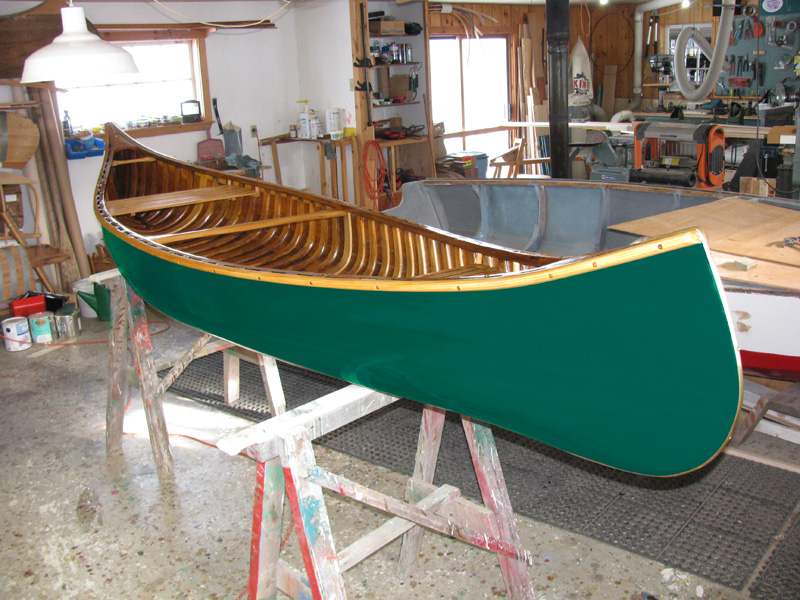
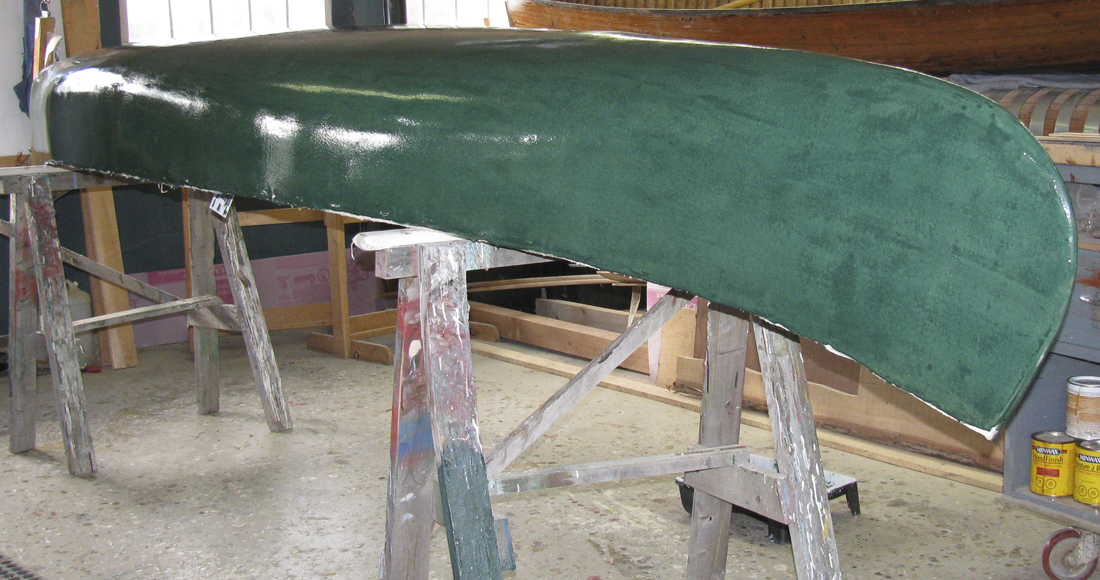
The filler needed only a light sanding to prepare it for painting. Three coats of a dark green marine enamel was applied with light sanding between coats. When the paint was dry it was time to install the gunnels and gunnel caps. One would think that the thin gunnels and caps would be easy to bend without steaming, but they aren't. I prepare a piece double thickness, steam bend it and clamp it to a form. When dry I remove it from the form and split it in two on the band-saw. All the pieces are sanded, sealed and varnished before installation, a final coat is given after installation. The painted hull exterior easily get scuffed and scratched when the gunnels are installed. I like to apply the final coat of paint after the outside gunnels, that also gives me the opportunity to seal the seam between canvas and gunnel with paint .


Old Town Charles River awaiting pick-up


The 1912 Old Town Charles River was completed in late November and has been in storage awaiting spring and the customers pick-up of it. Now that spring is here I have taken it out of storage given it a dusting and made sure it is ready for its second century of service.


Friday, 16 March 2012

Northland Canoe V-stern


Northland Square stern canoe.
The Northland Square stern canoe is completed, at least my portion of the work. Now the owner will finish her; sand and refinish the interior as well as rebuild the seats.

Northland Square stern canoe. 


Tuesday, 21 February 2012

Northland Canoe 14 ft. V-stern


I am presently working on a Northland V-stern canvas covered canoe, a model you don’t see that often. This is the first of their V-stern canoes for me, although I have restored many Northland canoes over the years.

Northland Canoe deck with decal.

The company started out sometime in the mid 1940’s just north of Huntsville. The present owner, Albert Maw, started with the company in 1956 as an employee and purchased the company in 1964. At one time the company produced up to 200 canoes a year with a lineup of eight different models.  A fire destroyed the company and its assets in 1995. Northland Canoes is still in business, although today only as a one man shop doing mostly repairs.
This Northland square-stern canoe was covered in a #10 canvas and filled with a polyester resin. A practise the company started in the 1960’s; later the canvas covering was replaced with fiberglass cloth on all their canoe models. A polyester resin was also brushed on the interior woodwork substituting varnish.

Removal of canvas glued to the hull.

Sanding to make the hull smooth enough for the new canvas.
The canvas was well glued to the hull especially on its sides. So, I knew I was in for many hours of unpleasant work with a heat gun and putty knife, followed by a lot of sanding to make the hull exterior smooth enough for the new canvas covering.

The canoe was planked with white cedar, mostly flat sawn. As is common, with canoes planked with flat sawn planking there is a fair amount of buckled planking which need work, especially as the distance between planking tacks on this canoe was too great. I have replaced the planking with the worst buckling and cracking, in some areas re-nailing and adding extra tacks was sufficient to flatten out the buckled plank. When all tacks were well clinched and secure I carefully sanded the hull followed by an oiling of the hull exterior with a mixture of linseed oil and turpentine.


Stretching and stapling the canvas. 

View of v-stern with new canvas.

The canoe’s owner wanted to watch and help out with the re-canvas work, so that morning I had two extra hands which finished the work on record time. On a v-stern like this the canvas is folded around the transom and fastened down in bedding compound. The stern is then covered by a fitted trim piece, in this case made from cherry.


Application of mildewcide to the canvas.

Warmer weather and some sun the next day gave me the opportunity to move outside to apply a zinc-naphthenate mildewcide to the canvas covering. A smelly but absolutely necessary job if the canvas covering is going to last. Use of respirator and gloves is essential, and leaving the canoe outside to dry. You don’t want to breathe in the fumes from it. I apply the mildewcide with a foam brush and stop 4 or 5 inches short of reaching the sheer, the mildewcide will migrate down. 

In the old times of lead based canvas fillers this step wasn’t necessary as the lead in the filler was a very effective mildewcide.

Zinc naphthenate preservative.

A word of advice; If you are restoring or having your canoe restored don’t skip this step! Apply mildewcide to the canvas or purchase canvas which is pretreated with it. It is also a good idea to ad mildewcide to the filler, I do both. Without mildewcide treatment your canvas covering might not last more than a few years. 


Sunday, 5 February 2012

16' Chestnut Cruiser


A couple of months ago I wrote briefly about the 16’ Chestnut cruiser slated for restoration over the winter.

Chestnut Cruiser with Verolite  canvas covering.


Bow deck with a faint trace of  an
outline of a Chestnut decal.
I brought it into the shop a couple of weeks ago. There
was no serial number stamped into the stem, but I found
a faint outline and a small remnant of a Chestnut decal
on the bow deck. It's measurement; 16’ x 33 ¾” x 11¾”
the very narrow decks and the slightly rounded hull
bottom definitely identify it as a Chestnut cruiser the
“Kruger” model. I estimated the build date to be mid to
late 1950’s.

A number of building details, however, point to an earlier
building date, most likely in the 1930’s or perhaps even
earlier. Almost all the planking is slash cut (vertical grain
angled about 30 degrees) and so are most of the ribs,
seats are bolted directly to the gunnels, the thwarts have
the typical earlier well rounded shape with tapered ends, and the decks are slightly crowned and nicely undercut.  There are also signs that the bow and stern height have been cut down slightly, which indicates that it once had the early higher cruiser ends.


16' Chestnut Cruiser the "Kruger" model.

I have removed the last pieces of the Verolite canvas, the outside gunnels, the keel and almost two rows of the cheer planking. All of it more or less rotted away. The rot has spread to a good number of rib tips resulting in that at least 45 ribs need new ends scarphed in and three ribs need to be completely replaced. The hull interior needs a complete stripping of the varnish, which means I will have to wait for warmer weather as I don’t like to perform this work inside. More about this canoe later in the spring.

Wednesday, 1 February 2012

Chestnut Canoe Co, motor canoe


As a canoe builder and restorer I am often asked: Which is your favourite canoe? Well, it’s not one, I have many favorites; paddling canoes, motor canoes, sailing canoes, some are canoes with interesting stories and some are favourites because of their construction, design and style. Here is one favorite, the Chestnut motor canoe, a rare one. I will occasionally present a few others that I think are worthy of special mentioning.

Chestnut Canoe Co ad.

In the early 1900’s the internal combustion engine changed most aspects of life and commerce, on land and water. The most common small engine of the day was the single-cylinder, two-cycle engine often called “one-lunger” or “make-and-break”. One-lunger referred to the single cylinder and make-and-break referred to the ignition system. This little motor was used as marine engines, stationary engines powering farm equipment, sawmills, and washing machines, and much more. It was the choice motor for fishermen and pleasure boaters alike for the next two decades beginning around 1900. Motorized boats found an eager audience in a growing population with time and money to spend.


E. M. White motor canoe ad.

One of the first of the North American canoe builders to recognize this new market was the E.M. White & Co in Maine. Already in 1902 they had a stock model motor canoe for sale to the public looking for a new and modern way to get out on the water.

In 1905 the Chestnut Canoe Co was a small regional canoe maker, with its first catalogue just out, offering only three models. It is clear that the company a couple of years later was doing a very good business right across Canada with a large line-up of canoe models to choose from. Clearly, the Chestnut Canoe Co wasn’t shy about “borrowing” ideas and quickly had picked up on the idea of a motorized canoe. Their motor canoe, first offered in 1907, was an almost exact copy of the E. M. White & Company’s motor canoe with “invisible sponsons”.
The Chestnut Canoe Co introduced their 20 ft. freight canoe in 1907 and its hull was also used for the inboard motor canoe. Ten motor canoes were produced that first year.


The cross section above shows the peculiar shape of the hull and the built in invisible air chambers which were added onto the full length of a canvassed hull and extending below the waterline. The hull was then again canvassed, filled and painted, making the air-chambers completely sealed. These chambers make the craft so steady that it is practically impossible to upset it and they make the canoe so buoyant that it will support more people than can be crowded into it.

Chestnut foursome.

The Chestnut inboard motor canoes were made in two lengths; 18-ft. and 20-ft. A range of options and equipment were available such as; Harlow awnings, special chairs and seats, spray hoods etc.
The canoes came equipped with the customer’s choice of three versions of an engine made by the St. Lawrence Engine Co in Brockville, Ontario. Their basic single cylinder engine model was produced almost unchanged for sixty years. Each engine was hand built one at the time.

 By 1920 the inboard motor canoe models had disappeared from the Chestnut offerings and had been replaced with the new fad; the square stern canoe equipped with the outboard motor.

A Chestnut motor canoe with the invisible sponsons is quite rare, I know of only a handful, one of them in the collection at the Canadian Canoe Museum. Their canoe, or what is left of it, is unfortunately in poor condition and is missing all hardware, motor, propeller, tank and piping, bow & side steering wheels, rub rails, oak coaming, keel, seats, chairs and its canvas covering. Two feet of the stern have been cut off and replaced by a transom.

If any of you have a Chestnut motor canoe for sale, I am interested.


Wednesday, 28 December 2011

Peterborough Muskrat


Just in time for Christmas, I was able to finish the Peterborough Muskrat. Actually, I sneaked out late Christmas Eve to install the new brass stembands. The old clunky and partly rotted outwales were replaced with a new set of Peterborough style D-shape white ash outwales. I am very pleased with the result and I hope the customer will feel the same when he sees it.


The quarter thwarts are not original, but a great add-on, handy when lifting the canoe and helps keep the ends together. I also installed a new Peterborough deck decal on the bow deck.


Saturday, 17 December 2011

Repair progress on the Peterborough Muskrat and Burleigh Falls canoes.


Where did the time go, it's more than three weeks since my last post? Well I've been busy.

Coamings, decks and king planks

The Burleigh Falls cedar-strip received two more coats of tungoil, repair and clean-up of the cedar decks and I made two new deck coamings as well as king-planks.

The Peterborough "Muskrat" has progressed well.

Oiled and varnished

Canvassed

Rubbing out filler

It is now dressed in new canvas, filled with quick drying soy-oil/silica filler.

Two coats of primer

I've primed it twice, the last primer coat coloured green. It got a couple of new ribs, a few minor backside rib repairs, about 50 ft. of new planking, stem repairs to both ends as well as repairs to the inside gunneltips. I also made a new bow slat-seat and repaired the stern seat.