Showing posts with label canvas covered canoe. Show all posts

Friday, 26 February 2016

Sectional Canoes


A canoe takes up a fair amount of space to store or to transport. It is not surprising that people have been looking for ways to get around this problem for as long as canoes have been made.

Dr. C. M. Douglas’ decked sectional canoe “Harmony”

Harmony a decked sectional canoe built in 1863/64


The well-known canoe “Harmony”, built in 1863/64, a decked sectional canoe owned, paddled and described in many magazine articles by Dr. C. M. Douglas, was likely the world’s first sectional canoe. It is also speculated that it inspired the building in 1865 of the Scotsman John MacGregor’s very famous “Rob Roy” decked cruising canoe. 


Dr. Douglas had “Harmony” built in England in 1863/64 by William Biffen of Hammersmith, near London. W. Biffen was a well-known boat builder of rowing skiffs and an inventor with a patent for sectional rowing shells under his belt. It is believed that Dr. Douglas saw W. Biffen’s exhibit of a yacht’s portable boat and sectional racing shells at the London International Exhibition in 1862 and commissioned Harmony built after the same concept. Harmony is 19'-10" long and with a beam of 24".


Originally, Harmony was a sectional canoe of three parts for ease of shipping and storing. Dr. Douglas used her for a couple of years in England. Then, on being assigned duty in India, Harmony was shipped to Lake Charles near Quebec City, where she was stored for 19 years. When he retired from service in 1882 Dr. Douglas brought her to his newly acquired farm Northcote in Lakefield, Ontario. He later converted her into a one-peace decked canoe and raced “Harmony” successfully for many years as a member of the Toronto Canoe Club. Newspapers of the time noted that Dr. Douglas often beat competitors who where 25 years younger paddling canoes which were 25 years newer.

Today “Harmony” can be found in the collections of the Canadian Canoe Museum.


Walter Dean Canoe & Boat Co

The well-known canoe builder Walter Dean of Toronto designed and patented what was probably the first North American made sectional canoe in 1898. Dean described the vessel in his 1898 catalogue: 

'We now come to something entirely novel and startling in the idea of cutting a canoe in pieces and making it sufficiently strong and water-tight". 

The canoe was built in three sections which nested inside each other for ease of transportation to the intended market in the north and specifically the Klondike gold rush. This canoe model was so successful that in 1898-99, Walter Dean had to enlarge the boat shop four times.The canoe sold well, but as the gold rush dwindled so did the demand for the Klondike sectional canoe.


Ontario Provincial Air Service

The next generation of sectional canoes was developed by Jack F. Hyde of Ontario Provincial Air Service. In the spring of 1924 the Ontario Provincial Air Service was formed by the Ontario Government to help protect the province’s vast forests. They set up their headquarters at the edge of St. Mary’s River in Sault St. Marie with their initial fleet of 13 World War I surplus Curtiss HS-2L flying boats.


Jack F. Hyde had joined the Air Service in 1924 as a rigger/fitter. He was adept at finding innovative solutions to operating problems and was soon appointed aircraft foreman and in 1929 Plant Superintendent.

Longitudinal sectional canoe
Beaching and mooring a flying boat was often a difficult task which would have been much easier if the crew had a canoe. Hyde designed a traditional canvas covered canoe which was split down the keel in two sections. These sections were secured to either side of the flying boat’s fuselage, forming two fairly aerodynamically acceptable bumps. When need arose to use the canoe, the two halves were merely removed and assembled. 

It is likely that Hyde had a little help to start with from two Sault St. Marie canoe builders; Joseph and Ben Richards from J.A. Richards & Sons, later St. Mary’s Canoes, who had been in business nearby since 1912, building traditional canvas covered canoes. 
Hyde’s first longitudinal sectional canoe design was followed by others as new airplanes replaced the flying boats.

In 1927 new designs were patented which divided the canoes crosswise in three and four sections respectively, still using the same simple, quick and effective assembly system. 

The Air Service built the sectional canoes for their own use as well as for the Ontario Forestry Branch.
In 1929 Western Canada Airways had the airplane ski manufacturer Elliot Brothers of Sioux Lookout to manufacture Hyde sectional canoes that could be carried inside their Fokker aircraft. 


Peterborough Canoe Co and Chestnut Canoe Co

In the mid 1930’s Chestnut Canoe Co. and Peterborough Canoe Co. introduced their own models of sectional canoes for aircraft transportation as the market for such grew.
Other canoe builders quickly followed.


Linkanoe
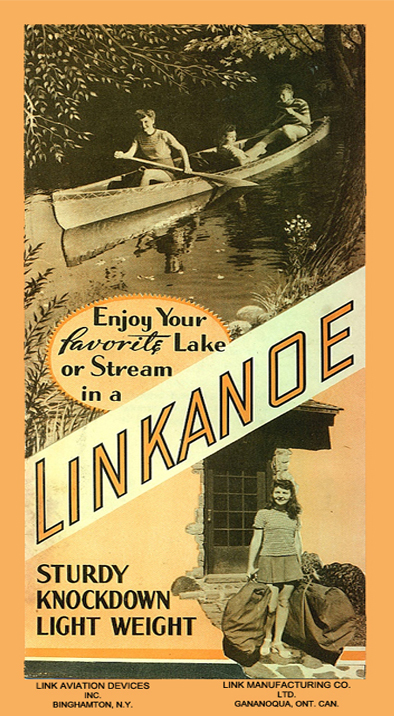
At the end of WW2,  Edwin A. Link a world renown aviation pioneer and the inventor of the flight trainer was searching for a way to keep his factories open. In the fall of 1945, he introduced his version of a sectional canoe. 

The components of the”Linkanoe” came in two bags, and the canoe could be assembled in less than ten minutes. Ten sections of wood-reinforced Mikarta, were assembled and locked together to form the hull, which was then waterproofed by fitting a canvas sheath over it, which was attached to a series of hooks, beneath the outwale. Thwarts, seats, and two paddles completed the outfit.

Early advertising brochures touted the canoe’s sturdiness, good handling, and portability. ”Check it like luggage, stow it in the closet, or leave it in the trunk of your car,” the canoeist was urged. The canoe’s capacity was also a selling point; a 1945 advertising photo showed Ed Link in his canoe with a moose he had shot on a hunting trip. About 4000 Linkanoes were produced and sold between 1945 and 1949.


The sectional canoe is an example of a uniquely Canadian industrial development and design. They have served an important part in developing the North.

Collapsible and folding canoes are other examples of innovations and developments with significant stories to be told. Now, that is a story for another time.

Sources:
Ron Pellinen                                                          American Canoeist Feb. 1884        
Kathy Hooke                                                          American Canoeist Feb. 1887                                                                    
Roger MacGregor                                                   American Canoeist Sept. 1886  
George Mersereau                                                 Badminton Magazine April 1897                                     
Linkanoe  catalog 1945                                         Wings over the Bush by A.R. Fenwick,                                                                               
The Nautical Magazine 1863                                 Walter Dean Canoe and Boat Co catalog 1901                           
Forest and Stream July 1885                                 Peterborough Canoe Co and Chestnut Canoe Co catalogs 1935


Saturday, 31 January 2015

The Peterborough Canoe Co models: the High-end and Low-end Champlain


From left 1940's High End Champlain,  Early 1920's 604. Late 1920's 16 S. all of them built on the same form.

During winter, work slows down a bit and so do visits to the store and shop. However,  
most  Saturday mornings see customers and visitors drop in. Some stay around for a cup 
of coffee and canoe stories around the warm wood stove. Recently, one of my visitors wanted to know, how many different brands of canoes I had worked on, which were they and which model of them was the most common.

So I checked through my old files and notes; it all added up to a list of forty one names of old  famous canoe makers and some lesser known ones which had passed through my shop.

The most common ones are;
  1. Chestnut Canoe Co
  2. Peterborough Canoe Co
  3. Lakefield Canoe Co
 I     I was not surprised that the Chestnut Canoe Co and Peterborough Canoe Co took the 
 lead with Lakefield Canoe Co as a distant third. Those three companies, together, 
 produced an incredible amount of canoes over their life span and my shop is located right 
 in cottage country just north of Peterborough and Lakefield. As to the most common 
 models I have worked on, here is the group that was way ahead over the rest.
  1.      The 16’ Low End Champlain #1492 from Peterborough Canoe Co 
  2.        The 16’ Pal from Chestnut Canoe Co. 
  3.        The 16’ High End Champlain #1434 from Peterborough Canoe Co.
The visitor who asked the questions got very excited when finding out that the 
Peterborough model, the high end Champlain, had made the list, as it is the canoe he paddles. He now inquired, did I know how long time this model was in production and 
did I know anything about its background? 


Here is a little bit of background on the Champlain models.


Peterborough High-end Champlain and Peterborough Low-end Champlain


The Peterborough Canoe Co. model the "Champlain" showed up for the first time in 1936  in two versions, the “High-end” version with the model number 26P and the “Low-end”  version with the model number 26C. They were, however, just new names on models that  had been built for quite some time.The P stands for the Pleasure model and the C stands  for the Cruiser model. The monikers  High-end and Low-end has nothing to do with the  quality of the canoes, it actually describes  the height of the stern and bow. 

The Champlain models became the company's most popular canvas covered models.


The  Champlain High-End

The "High-End" Champlain model was produced between 1936 and 1955. In 1939 its model number was changed from 26P to #1434. However, before 1936, this model was actually called 16S or the Special and had been introduced for the 1923 model year as a less expensive model to their top of the line 604 model. (The 604 model changed name to the Otonabee in 1924).

16 S model, Peterborough Canoe Co.


The  Champlain Low-End

The Low-end Champlain was recommended for use in camps, tourist resorts and boat liveries where a light, stable and easy-to-portage canoe was desired. It was introduced in 1936 with the model # 26C. So was this really a new model? No it was not! 


It was introduced for the 1924 model year as the Algonquin (first grade) and the Huron (second grade). In 1936 it became the Champlain 26C and in 1939 the model number was changed to #1435. In 1942 the model number changed again, this time to #1492. 

The model Low-end Champlain was available until the end of 1962, when the Peterborough Canoe Co. went out of business. It is worth noting that the Peterborough Canoe Co never built the Low-end Champlain model. It was built for them by their sister companies Chestnut Canoe Co and occasionally by the  Canadian Canoe Co. This Peterborough model is actually the same canoe the Chestnut  Canoe Co built and sold under the names Ajax, Moonlight and after 1954 with the name  Pal.


Thursday, 20 February 2014

Chestnut Canoe Co. the Peach model


About 10 years ago I restored a couple of early 14' canvas covered canoes built by the Chestnut Canoe Co. Unfortunately, I lost the CD containing most of the pictures from those restorations. Last weekend the lost CD was found so here are some of the pictures and a write up on one of the restorations.


14' Chestnut Peach
Almost 100 years ago, in May of 1914, 
this canoe was purchased from the 
Chestnut Canoe Co dealer Ketchum & 
Co in Ottawa, by my customer’s great 
grandfather to be used at the then new 
family cottage at Britannia Bay just 
outside Ottawa.

The canoe had been used by several generations and was now well patched 
with duct tape, but otherwise in good condition. However, it needed new canvas, replacement of 3 ft. of planking, 
repair to the inwales, careful stripping of 
the varnished interior and new seat caning.  


After stripping the canoe of its old varnish the real condition of the hull could be observed. The hull was remarkably well preserved and true for a canoe this old. A quick check in an old Chestnut catalog and I could identify the canoe as a 14' Peach model 2nd grade. Proof of this was quickly found; the stripping highlighted ribs and planking with small knots and not the best grain orientation. 


Stripping of hull interior
Chestnut Peach deck with old style decal


The Chestnut canoes built in Fredericton, N.B. before the fire of December 1921 were significantly different from what was produced later. During the rebuilding of the factory, forms and jigs for most canoe models were changed. The side's "tumble-home" and the "kick-up" of the shear line in the bow and stern were reduced and many other smaller changes, all in order to speed up production and generate higher profits. 


How to recognize a prefire Chestnut.  


As mentioned above look for considerable tumble-home and high bow and stern profiles, closed gunnels or as here open gunnels where the rib tips are tapered and feathered along the decks to taper and close up the distance between inner and outer gunwales. Take also note of the peculiar notching of the stem tips. The thwarts should be nicely shaped with tapered ends. Seats might have sculpted frames and should be bolted directly to the gunwales without spacers. If your canoe is a pleasure model it should also have heart shaped, crowned and undercut decks and of course an old style decal if present. 


Chestnut Peach bow interior
Stem detail


Plugging the old gunnel screw holes 

The interior re-varnished, new canvas installed, filled, sanded and painted. Here I am gluing in small wood plugs in the old screw holes to make ready for installation of the out-wales. 
                                                                                     
14' Chestnut Peach ready for new adventures.
Isn't this a sweet canoe? Here it is ready for another 100 years of adventures.

Chestnut Peach - nice curves
Chestnut Peach bow


After taking the lines of the Peach for future builds it was off  to the beach for a test paddle.

Jeremy Ward test paddling the restored Chestnut Peach