 |
| 1912 Old Town Charles River wood canvas canoe |
100 years ago, in January of 1912, this classic wood canvas
canoe took shape in the factory of Old Town Canoe Co in Old Town, Maine. In mid April the same year it was wrapped in oiled paper and burlap with hay
for cushioning and taken to the railyards for shipment to Goodwins Limited, a well-known mail-order and department store at the time, in
Montreal, Quebec. The canoe was purchased that spring by my customer's grandfather and has stayed within the family ever since.
 |
| Old Town Charles River canoe. |
The canoe had suffered the usual discolorations,
blemishes and scars which come from long use and old age. At some time an excited hunter had "accidently" shot the canoe not once but twice. One must wonder what the canoe had been mistaken for????
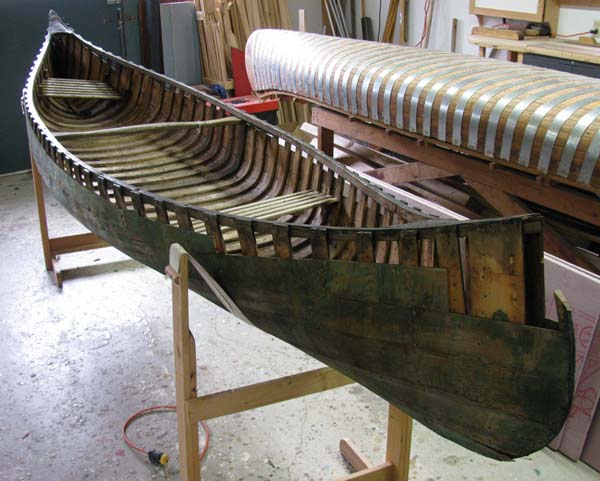
The canoe had had the canvas replaced sometime in the 1970's and the original seats and thwarts replaced with generic ones. After stripping the canoe of its old varnish the real condition of the hull could be observed. The hull was remarkably well preserved and true for a canoe this old. I was however surprised over the dark varnished interior. It was clear that this canoe must have been stained and then varnished at the factory.
The gunnel caps and outer gunnels were beyond repair. The inner gunnels needed repairs midships as well as at the ends. There were rot in the stems, so fresh wood needed to be spliced in at both stems. The canoe also needed five new ribs, a couple of rib-tips, about twenty feet of planking, a new keel, brass stem-bands, and of-course new seats and thwarts patterned from another early Old Town I restored a couple of years ago.
 |
| Work in progress |
With the stripping of the hull interior done, I removed the decks and spliced in the new gunnel ends and stem pieces as well as repaired the breaks in the gunnels amidships. The five broken ribs and rotted rib tips were next to be replaced. About twenty feet of severely cracked planking were also replaced. The chemical stripping of the hull interior removed most of the dark stain. However, several applications of bleach, stain removers etc would not remove all staining, the wood still had a blotched appearance. I am not a fan of stained wood, but in this case I used a stain, as the canoe had had originally, to even out the blotched appearance of the wood.
 |
| New seats and thwarts Restored deck |
A light sanding of the interior prepared the wood for a mix of a diluted Minwax stains called English Chestnut and Golden Oak. The result was very close to the original colour, only lighter. The interior then received four coats of varnish with the last coat cut from gloss to a satin.
 |
| Application of filler. |
The hull exterior was sanded smooth and treated with tung oil followed by a coat of varnish. A couple of days later the canvas went on without a hitch. The canvas was as usual treated with a zink-naphthenate mildewcide after installation. A smelly but absolutely necessary job if the canvas covering is going to last. Use of respirator and gloves is essential, and leaving the canoe outside to dry. You don't want to breathe in the fumes from it. In the old times of lead based fillers this step wasn't necessary as the lead in the filler was a very effective mildewcide.
 |
| Installation of gunnel caps. |
The filler needed only a light sanding to prepare it for painting. Three coats of a dark green marine enamel was applied with light sanding between coats. When the paint was dry it was time to install the gunnels and gunnel caps. One would think that the thin gunnels and caps would be easy to bend without steaming, but they aren't. I prepare a piece double thickness, steam bend it and clamp it to a form. When dry I remove it from the form and split it in two on the band-saw. All the pieces are sanded, sealed and varnished before installation, a final coat is given after installation. The painted hull exterior easily get scuffed and scratched when the gunnels are installed. I like to apply the final coat of paint after the outside gunnels, that also gives me the opportunity to seal the seam between canvas and gunnel with paint .
 |
| Old Town Charles River awaiting pick-up |
The 1912 Old Town Charles River was completed in late November and has been in storage awaiting spring and the customers pick-up of it. Now that spring is here I have taken it out of storage given it a dusting and made sure it is ready for its second century of service.




 Posts
Posts


