Showing posts with label Lakefield Canoe Co. Show all posts

Saturday, 31 January 2015

The Peterborough Canoe Co models: the High-end and Low-end Champlain


From left 1940's High End Champlain,  Early 1920's 604. Late 1920's 16 S. all of them built on the same form.

During winter, work slows down a bit and so do visits to the store and shop. However,  
most  Saturday mornings see customers and visitors drop in. Some stay around for a cup 
of coffee and canoe stories around the warm wood stove. Recently, one of my visitors wanted to know, how many different brands of canoes I had worked on, which were they and which model of them was the most common.

So I checked through my old files and notes; it all added up to a list of forty one names of old  famous canoe makers and some lesser known ones which had passed through my shop.

The most common ones are;
  1. Chestnut Canoe Co
  2. Peterborough Canoe Co
  3. Lakefield Canoe Co
 I     I was not surprised that the Chestnut Canoe Co and Peterborough Canoe Co took the 
 lead with Lakefield Canoe Co as a distant third. Those three companies, together, 
 produced an incredible amount of canoes over their life span and my shop is located right 
 in cottage country just north of Peterborough and Lakefield. As to the most common 
 models I have worked on, here is the group that was way ahead over the rest.
  1.      The 16’ Low End Champlain #1492 from Peterborough Canoe Co 
  2.        The 16’ Pal from Chestnut Canoe Co. 
  3.        The 16’ High End Champlain #1434 from Peterborough Canoe Co.
The visitor who asked the questions got very excited when finding out that the 
Peterborough model, the high end Champlain, had made the list, as it is the canoe he paddles. He now inquired, did I know how long time this model was in production and 
did I know anything about its background? 


Here is a little bit of background on the Champlain models.


Peterborough High-end Champlain and Peterborough Low-end Champlain


The Peterborough Canoe Co. model the "Champlain" showed up for the first time in 1936  in two versions, the “High-end” version with the model number 26P and the “Low-end”  version with the model number 26C. They were, however, just new names on models that  had been built for quite some time.The P stands for the Pleasure model and the C stands  for the Cruiser model. The monikers  High-end and Low-end has nothing to do with the  quality of the canoes, it actually describes  the height of the stern and bow. 

The Champlain models became the company's most popular canvas covered models.


The  Champlain High-End

The "High-End" Champlain model was produced between 1936 and 1955. In 1939 its model number was changed from 26P to #1434. However, before 1936, this model was actually called 16S or the Special and had been introduced for the 1923 model year as a less expensive model to their top of the line 604 model. (The 604 model changed name to the Otonabee in 1924).

16 S model, Peterborough Canoe Co.


The  Champlain Low-End

The Low-end Champlain was recommended for use in camps, tourist resorts and boat liveries where a light, stable and easy-to-portage canoe was desired. It was introduced in 1936 with the model # 26C. So was this really a new model? No it was not! 


It was introduced for the 1924 model year as the Algonquin (first grade) and the Huron (second grade). In 1936 it became the Champlain 26C and in 1939 the model number was changed to #1435. In 1942 the model number changed again, this time to #1492. 

The model Low-end Champlain was available until the end of 1962, when the Peterborough Canoe Co. went out of business. It is worth noting that the Peterborough Canoe Co never built the Low-end Champlain model. It was built for them by their sister companies Chestnut Canoe Co and occasionally by the  Canadian Canoe Co. This Peterborough model is actually the same canoe the Chestnut  Canoe Co built and sold under the names Ajax, Moonlight and after 1954 with the name  Pal.


Sunday, 16 September 2012

Perdita II a decked cedar-strip canoe built by Lakefield Canoe Co.


A couple of months ago I wrote about one of my favourite canoes, the Chestnut motor canoe. To continue on this theme, this story is about another favourite; a decked cedar-strip canoe built by the Lakefield Canoe & Mfr. Co. in 1907.  It once belonged to George M. Douglas and is today part of the Canadian Canoe Museum’s collection. Its name is Perdita II and it can be found in the Canadian Canoe Museum’s gallery “The Peterborough Tradition” where it hangs upside down in the ceiling.

Perdita II, a decked cedar-strip canoe built by the Lakefield Canoe & Mfr. Co.
I came across Perdita II for the first time in the fall of 1997 when identifying and documenting canoes for the Canadian Canoe Museum. What caught my eye was the narrow width, only 24" and the round to V-shaped hull bottom. A true reflection of the racing dugouts that once raced on the lakes and rivers of the greater Peterborough region in the mid 1800's. Perdita II takes on greater significance, as regretfully very little material evidence of the racing dugouts of that time remains.

It is a canoe I sponsor through the Canadian Canoe Museum’s cool fundraising program “Adopt-a-canoe”.

For just $15/month you can also adopt one of the canoes in the Museum’s collection. Find out more about the fundraising program and how to adopt your canoe here:  http://support.canoemuseum.ca/index.php?option=com_jcollection&view=category&catid=1:adopt-an-artifact&Itemid=2

This is the story of this canoe; actually, it is the story of three canoes; the old racing dugout Perdita, and two decked cedarstrip canoes; Perdita I and Perdita II.


In 1884 the two young brothers George and Lionel Douglas fished a racing dugout out of the waters of Katchewanoka Lake just north of Lakefield. Their father, Dr. Campbell Mellis Douglas, an avid canoeist, canoe collector and inventor, took an interest in the dugout and brought it to the Lakefield canoe builder Thomas Gordon. The old leaking dugout was restored and fitted with new butternut decks by Thomas Gordon and Charles Grylls. The old racing dugout got a new lease on life and was named Perdita. The Douglas family named their canoes and boats after Shakespeare characters. Perdita was the name of a character out of A Winter’s Tale.

Perdita was enjoyed by the Douglas family and its visitors for many years. Although a refined and well-built craft with uniform hull thickness and long fluid lines, it suffered all the usual dugout problems; crankiness, excessive weight and of course the bane of all dugouts; severe cracking of the hull. In early 1893 the dugout was again brought to the Lakefield canoe builder Thomas Gordon, who converted the old dugout to a mold from which the hull of Perdita I, a decked cedar-strip canoe was produced.


Perdita I a decked cedar-strip canoe built by Thomas Gordon.
In 1894, Dr. Campbell M. Douglas applied for a new commission in the British Army to pay for his children's education. The family farm “Northcote” was sold to much distress of the boys George and Lionel. The family moved to England and with them came a handful of the collection of canoes and boats, among them Perdita I.  The canoe was kept at Easton Lodge, the private residence of Countess of Warwick who was a friend of Dr. Douglas.

Dr. Campbell M. Douglas and his son George paddling
Perdita I at Broughty  Ferry,  Scotland  October 4, 1899.
With his education taken care of, George Douglas revisited Canada and Lakefield several times and finally bought back the family homestead, “Northcote” in the summer of 1907.

During George Douglas time in England, the Lakefield canoe building firms Thomas Gordon and Strickland & Co had amalgamated to become the Lakefield Canoe & Mfg. Co. Inquiring there about the whereabouts of the old racing dugout mold “Perdita” George was successful in finding it. He placed an order in the fall of 1907 for Perdita II to be built on the same old dugout mold by the Lakefield Canoe & Mfr. Co. 

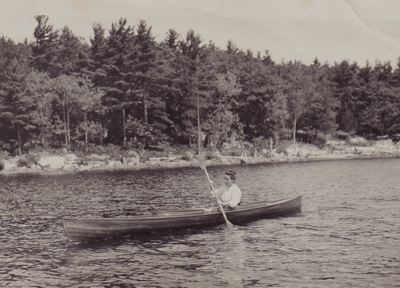
Perdita II paddled on Katchewanoka Lake, Lakefield
After the death of his father Campbell M. Douglas in late 1909, George managed to secure the return of the Perdita I to Lakefield after a lengthy correspondence with the Duchess of Warwick who reportedly felt an attachment to the canoe.  Both canoes were now part of an growing fleet of canoes and boats at "Northcote" to the enjoyment of the many visitors over the next 50 years.

Perdita I is today in a private collection and Perdita II in the Canadian Canoe Museums collection. The racing dugout/mold Perdita was most likely destroyed in the December 23, 1910 fire of the Lakefield Canoe & Mfr. Co

Thank you to Kathy Hooke for the access and use of the Douglas family photos and diary's.